
How MSP Arrests Fit the State Map
Massachusetts State Police operate statewide, covering patrol, investigation, tactical units, and support services. A statewide remit does not mean every arrest becomes a state-held jail record, though. MSP officers work defined patrol areas. Their role can differ from the local police department, county sheriff, court, or jail tied to one event.
The official troop map labels those areas A Northeast, B West, C Central, D Southeast, F Logan Airport, and H Metro Boston. Those labels describe patrol geography and nothing more. A troop is not a barracks. A county line is not a court district. Near a border, a highway, or Logan Airport, it matters even more. Confirm which agency made the arrest. Then check which custodian held the person after booking.
The Massachusetts State Police organization page lays out the agency's statewide functions. That scope explains why an MSP release may describe an investigation crossing municipal lines. Yet it may still point to no single universal booking location.
The official MSP organization page gives the agency name and statewide context used to read its arrest notices.
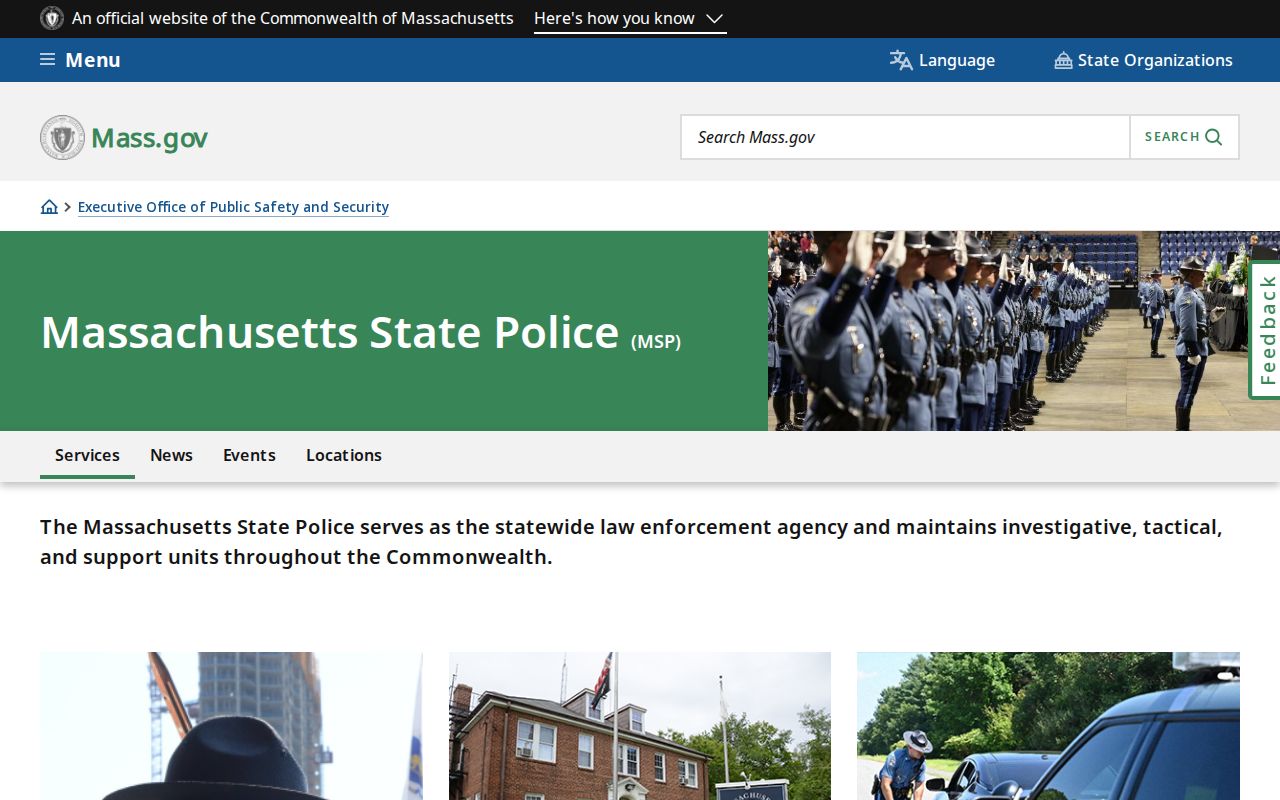
This source tells you who issued a notice. It is not a jail roster, and it is not a record of any court outcome.
Where MSP Arrest News Appears
The agency's dated news archive is the main current source. It works well for major events and announced operations. It is selective by design, though. One release might cover a large arrest, a search, a crash, a missing-person case, a joint investigation, or a public-safety campaign. It will not list every person MSP arrests. It will not list every charge filed, or each booking made during a day. The publications serve different purposes and date ranges. Match the source to the question. Do not treat every MSP page as a live feed.
| Official source | What it can show | What it does not establish |
|---|---|---|
| MSP news archive | Dated press releases, agency descriptions, and selected arrest or enforcement details. | A complete roster, current custody, or every arrest made by MSP. |
| MSP Arrest Details files | Historical NIBRS arrest-detail material for Field Services and Investigative divisions. | A current daily dispatch log or same-day booking list. |
| Operation and enforcement releases | Results the agency chose to report for a named initiative, such as citations, summonses, arrests, or tows. | A record of every stop or person contacted during the operation. |
| MSP public-records process | Agency records that can be located and released after review. | An automatic release of every requested record or photograph. |
Read a release listing an arrest with its date. Check the agency name, narrative, and stated charges together. The release reports what MSP said at the time. It is not a court docket or a booking sheet. Later case details live in the court record and may differ from the first release.
Historical MSP Arrest-Detail Files
A separate Arrest Details list serves as a historical data source. It holds NIBRS arrest-detail spreadsheets for the Field Services and Investigative divisions. The files cover January 2019 through March 2020. You can search the files by division, date, location, and offense. That limited date range matters. A blank result outside the span does not mean no arrest occurred. A historical file is not a current booking feed.
These records answer a different question than the news archive does. A press release narrates one selected event. A NIBRS file organizes arrest details for its stated period and divisions. Neither gives a complete live view of who is in custody now. For an event inside that historical window, compare the file's date and division fields with the agency's own description. Then request the specific record if the public file lacks the detail you need.
The official Arrest Details list shows the historical file collection and its scope.
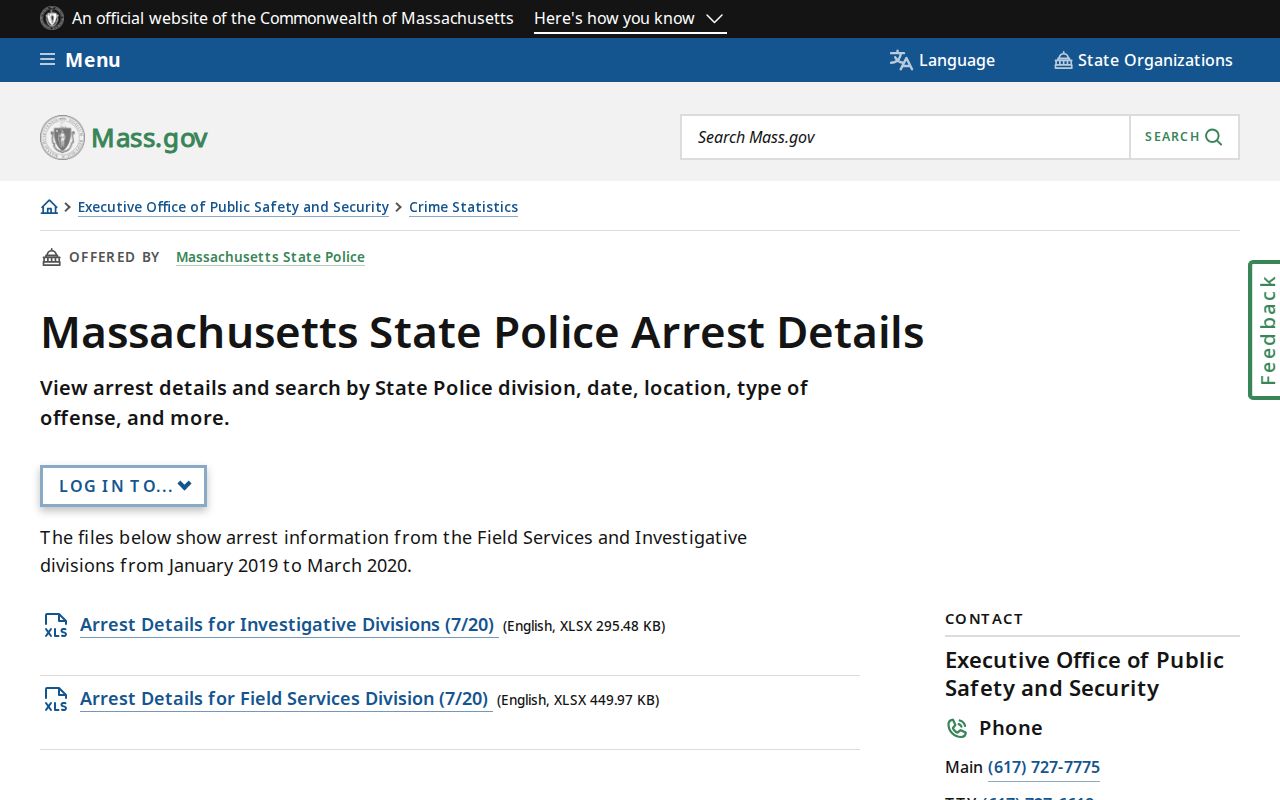
Check each file's own label and date before drawing any conclusion. These spreadsheets do not replace an incident report, a current-custody check, or a later court record.
A historical arrest file can help you locate an event. Its date range says nothing about today's MSP activity or anyone's present custody status.
How to Check an MSP Arrest Notice
Start with the agency's own publication. Then go to the record holder that matches your question. A press release fits an event MSP chose to announce. A booking roster fits present county custody. When a specific MSP report or image is not posted, a public-records request is the direct path.
- Open the MSP news archive. Check the date and read the whole release. Note whether it names MSP, a local department, or a joint operation as the source of the information.
- Use historical data only for its stated period. The Arrest Details list is relevant to its January 2019 through March 2020 files, not to a recent event outside that span.
- Ask who held the person after arrest. If the question is about current custody or a booking image, identify the local or county custodian. The statewide County Directory routes to the local arrest and booking resources.
- Request the specific record from MSP when MSP made it. Give the Public Records Unit a useful date, location, troop or agency, record type, and preferred format.
- Check the court record for later case events. A charge in an agency release may be amended, dismissed, or resolved in a different way.
MSP publishes no current daily dispatch log. It also publishes no complete statewide same-day arrest roster. The agency describes Dispatch Services and a Records Section. That alone does not create a public dispatch-log page. Someone missing from the news archive may still have been arrested. Absence of a press release settles nothing either way.
The c. 41, § 98F public-log statute covers municipal police logs and includes nonpublic categories. It does not show that MSP runs a public dispatch feed. The statutory log text helps with one distinction. It separates a basic municipal activity log from an incident report or investigative file.
The Massachusetts daily-log statute illustrates why a basic public log is a narrower record than a full report; it does not establish a public MSP dispatch log.
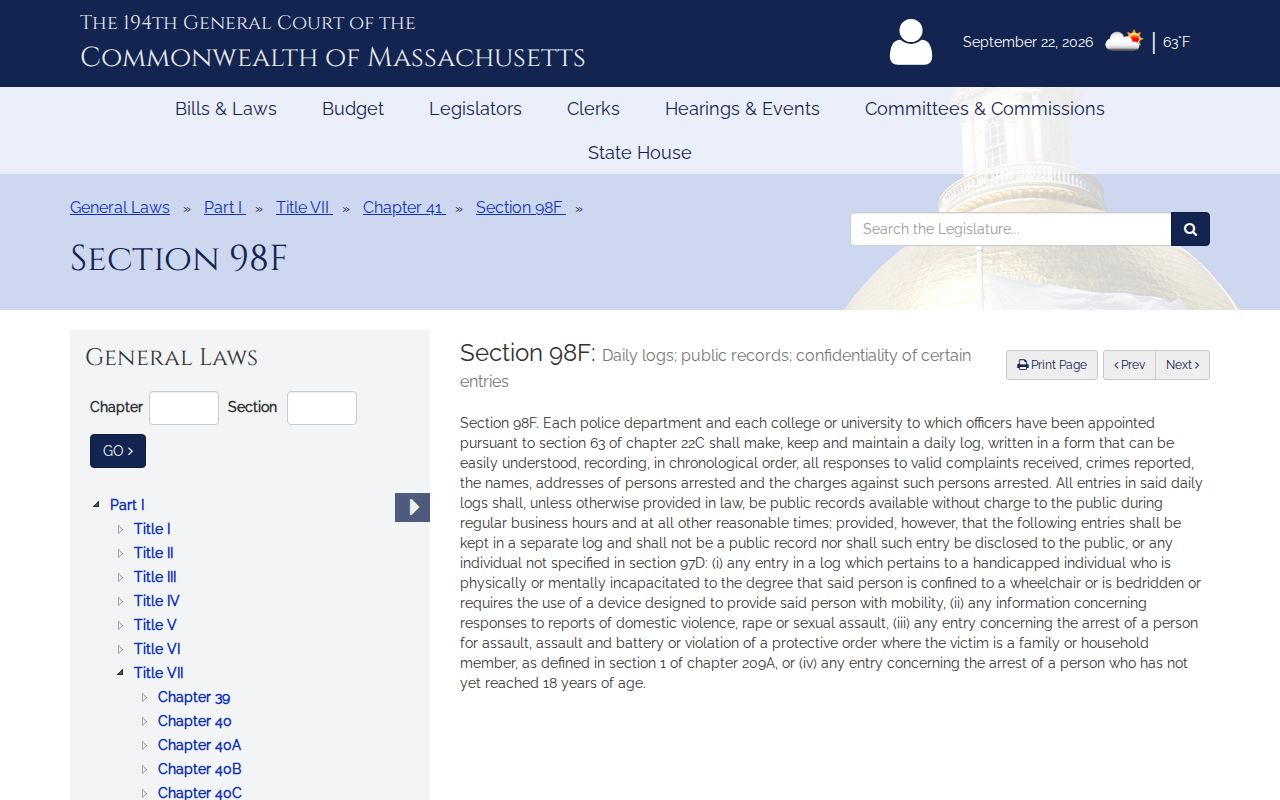
For an MSP event, ask the MSP records office for the particular report. Do not assume a municipal log rule supplies an MSP feed.
Where an MSP Arrestee May Be Booked
State police power and jail custody are two different things. MSP patrols the whole state, but it runs no statewide jail. After an arrest, the person may stay briefly with the arresting agency. A court appearance may come next. Or the person goes to a county sheriff's jail or house of correction, following the local custody order in place. Where exactly depends on the location, the bail question, medical or safety needs, and choices made in that one case. So there is no fixed county destination for every MSP arrest. Someone arrested near a county line, on a highway, at Logan Airport, or through a joint operation may take an extra check to sort out who holds them. The MSP troop map shows patrol geography only. It is not a jail-placement list. Ask MSP which agency made the arrest, then ask that sheriff or local department about current custody.
An MSP arrest notice names an arresting agency or investigation. It does not prove MSP still holds the person. Nor does it point to any universal county jail. Confirm custody with the agency or county custodian tied to that event.
Photos work the same way. The booking agency, not MSP, may hold a booking photo. That holds only if one exists and can be released. A news release can report an arrest with no portrait attached. A booking record does not make the photo public. Not every source shows one.
A person may later land in state prison. The Massachusetts Department of Correction's offender search covers that custody only. It is not a county booking record or a live arrest feed.
Request an MSP Arrest Report or Photo
The MSP Public Records Unit handles records access for the agency. Its pages spell out how to file. You can request online, by email, or by mail. A clear, specific request gets faster service than a vague ask for a statewide collection. Name the person or incident. Give the date and place. Add the troop or agency if known, the record type, and the format you want.
Use the official MSP public-records page and the MSP request instructions for the current method. Written requests go to the Public Records Unit at 50 Maple Street, Milford, MA 01757. The phone is 774-462-3770. Email works too: msp.rao@pol.state.ma.us. Remember, this covers MSP-held records only, not a county jail's booking records.
Massachusetts public-records requests run under M.G.L. c. 66, § 10 and 950 CMR 32. The first response usually comes within 10 business days. Extensions can apply. That first reply is not a promise of full delivery. The agency may still need to search, quote a fee, seek clarification, or cite a reason to withhold or redact material.
Fees are reasonable under MSP's instructions. Labor beyond the first four hours can cost up to $25 per hour. Copying, redaction, and segregation costs may add on. The exact fee depends on the record and the work involved. No special statewide mugshot fee exists, and no photo turnaround is guaranteed.
Release always depends on the case. A record may hold CORI, privacy, victim, witness, or investigative material that staff must review first. Some parts may be withheld or redacted under an exemption. You can ask for the releasable portions and the reason for any denial. Appeals go through the Supervisor of Records when appropriate. The statewide Arrest Record Laws guide explains these public-access limits in more depth.
- Describe one incident as precisely as possible. Include a date or date range, place, involved agency or troop, person or case identifier if known, and the specific report or photograph requested.
- Choose a delivery format. The request instructions allow online, email, or mail submission. State a preferred format and ask for an estimate if staff expect a fee.
- Keep the response and any fee notice. The first response may explain the search, timing, cost, or withholding basis. Narrow or clarify the request if that will help locate the record.
- Follow the review route if needed. Use the official appeal instructions if a request is denied or a dispute remains.
The Secretary of the Commonwealth's public-records guide explains the statewide response and fee framework that readers may encounter with an agency request.
The general guide adds context to the MSP-specific page. For submission and response details, rely on the agency's current instructions.
Crash Reports Have a Separate Route
A crash report is not an arrest report, even when the stop or crash led to an arrest. Massachusetts routes crash-report requests through the RMV. Its crash-report request page has the details. Expect a $20 fee. Waits run about four weeks. Federal Driver's Privacy Protection Act limits also apply to who qualifies.
Use that route only for the crash report itself. An arrest report or booking-photo request belongs elsewhere, even if a car was involved. For an MSP arrest or incident report, contact the MSP Public Records Unit. For a county booking record, contact the county or local agency holding it.
Arrest Reports Do Not Decide the Case
An agency release shows what MSP reported about an event at the time. The details can change as the case moves through court. A person's status can also change after booking. Release from custody does not erase the underlying public record, and a later court disposition is a separate event best checked with the court or the record custodian. When two sources differ, compare their dates and their roles. A news release may be early and brief. An incident report may carry redactions. A county jail roster shows only current custody, while the court docket may reflect later charges or a final result. One source never substitutes for another. MSP and the county custodian each hold records from their own work. A request sent to the wrong agency may return nothing, even when another office has the file. Start with the agency named in the release. Ask where the person was transferred. Keep the court outcome distinct from the arrest account.