
Access to Massachusetts Arrest Records
Most basic Massachusetts police-log entries and arrest registers are public. Booking photos are another matter. No statute grants a general right to publish them. Instead, the public-records law, CORI rules, privacy and investigatory exemptions, juvenile confidentiality, and court orders all shape what each custodian may release.
The custodian matters. A city police department holds the daily log. A sheriff or house of correction keeps local booking and custody material. The Department of Correction holds state-prison records. A court clerk keeps the docket entries. One record may be open in one form yet restricted in another. So name the record, the agency, and the date before you ask, since staff can find a narrow request far faster than a broad one.
State law supports access to certain logs, but limits still apply. A public entry may omit a portrait, victim details, a narrative, or active-investigation material. The answer is record-specific. Ask for the public log first. Then make a separate, narrow request for any other record that may be releasable.
Massachusetts Logs and Arrest Registers
M.G.L. c. 6, § 172(m) names police daily logs, arrest registers, and chronological arrest-type records as public. The municipal daily-log rule requires a chronological log of calls and complaints. The public version is free. Sensitive categories stay separate. That nonpublic log covers certain domestic-violence and sexual-assault responses, some family incidents and protective-order arrests, and any entry involving a person under 18.
The linked arrest-register statute carries the public-record language. Its text explains the gap. A basic arrest record may be public even when a booking image is not.
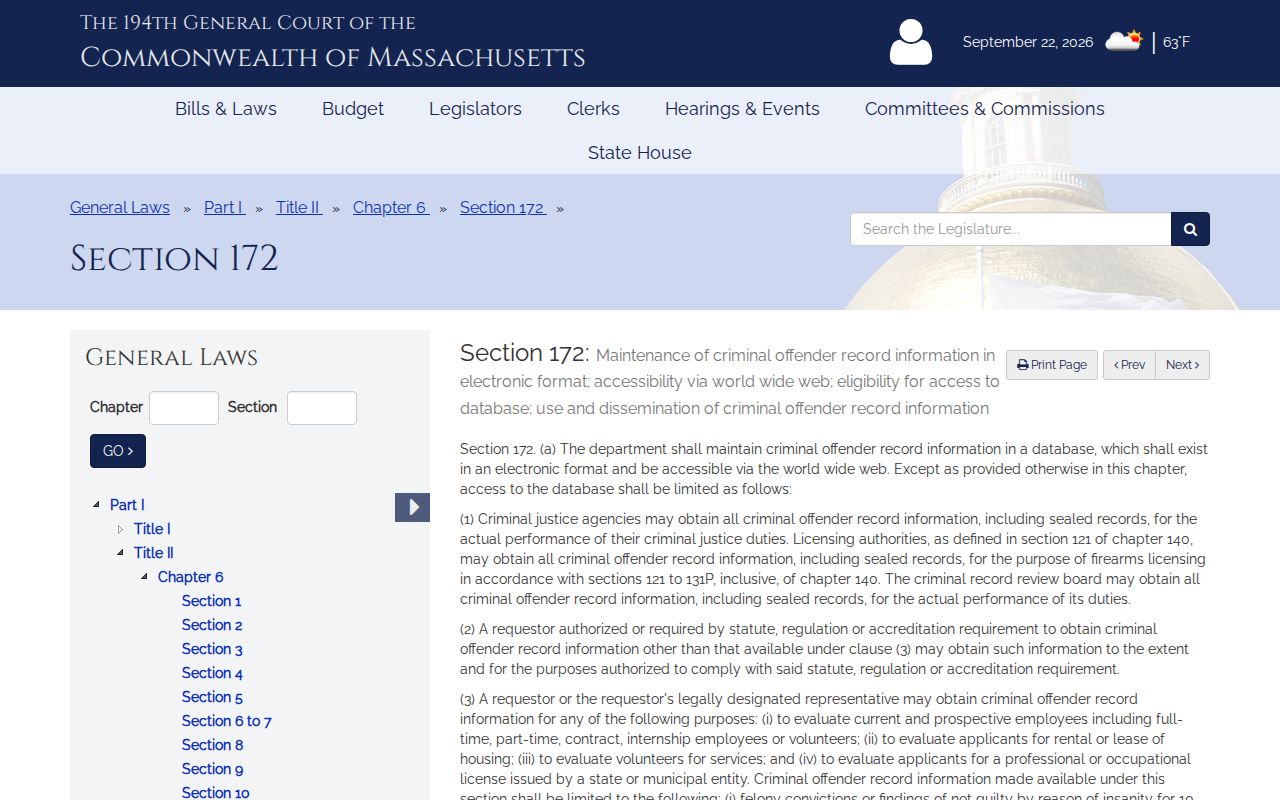
The statute page displays legal text, not a sample arrest entry. A daily log is a distinct record. It is not an incident report. It is not a dispatch recording, evidence file, or CORI history. A web page or PDF may show only the public-facing version. It may leave out the full statutory log. Details can be left out. Never assume the missing text sits in the public copy. Ask for the dated log itself when that is the record you need.
Massachusetts Separates Logs From Portraits
Public arrest logs and booking photographs live under different rules. A law that opens a log does not order a portrait posted. Booking photos may be taken for identification after certain felony arrests under M.G.L. c. 263, § 1A. Those rules cover making a record in specified cases. They do not command web publication.
A photo request gets judged case by case. Privacy can block release. So can an open investigation or protected victims and witnesses. The question is not whether a photo exists. Ask whether this custodian can release this image under current law. A log request is often the better first step.
In 2020, the Supreme Judicial Court decided Boston Globe Media Partners, LLC v. Boston Police Department. The court rejected a categorical rule that CORI made requested booking photographs of public officials exempt. It did not open every portrait. The ruling weighed the records and public interest at issue, and it left case-specific privacy analysis in place.
The municipal daily-log statute shows how a public log stays separate from protected material. The official page displays the rule and its listed exclusions.
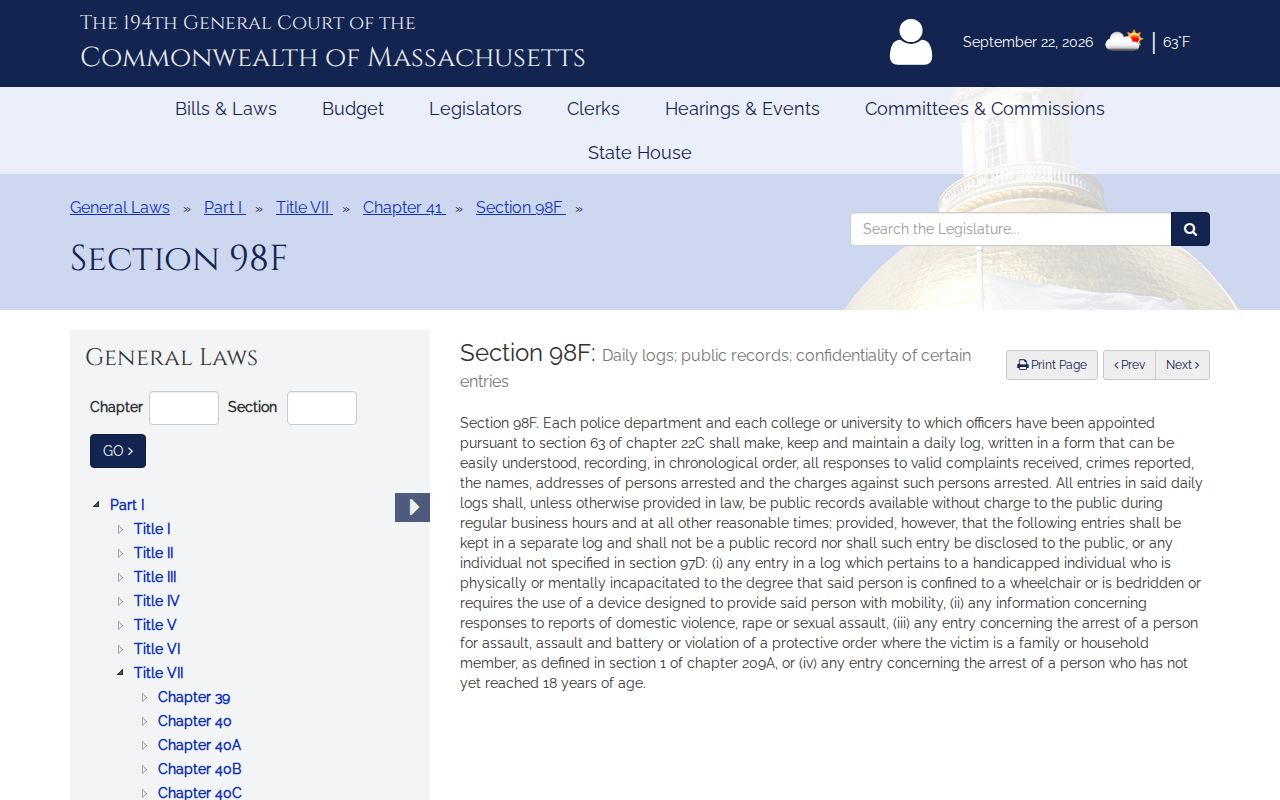
The 2020 opinion rejects blanket secrecy. It does not bless every withholding decision. The same split keeps public arrest logs apart from photo galleries, so an online portrait never stands in for the official record.
CORI, Redactions, and Records Requests
CORI means criminal offender record information. Under the CORI statute and 803 CMR 2, some criminal-history information is subject to access and dissemination limits. A booking photo is not automatically a CORI record, and a booking sheet can contain details whose status depends on the person, charge, disposition, and context. It is inaccurate to say either that CORI hides every arrest record or that a public log makes the full case file public.
The Secretary of the Commonwealth's public-records guidance explains written requests to an agency's records access officer (RAO), the official who receives and answers them. A request does not need a special phrase, but a clear description and preferred format help identify the record.
A focused request can follow this order:
- Identify the arresting agency or other likely custodian, plus the approximate date and incident.
- Name the exact record sought, such as the dated daily log, arrest register, booking record, or a specified photograph.
- Ask for an electronic copy when that format works and narrow the request to avoid unrelated records.
- Review any redaction or denial and the exemption stated by the agency. A custodian may protect private details or active investigative material.
- If a response is overdue or disputed, follow the Secretary's appeal route to the Supervisor of Records and consider judicial review where appropriate.
Agencies must answer in writing, usually within 10 business days. Statutory extensions can stretch that clock, and a broad request often takes longer. Fees must stay reasonable and tied to permitted work. Copying, redaction, search, and review costs may all apply under the law. Do not assume a photo or large file is free just because a municipal daily log carries no charge. When an agency posts no usable log, the statewide guidance is the place to start. The agency still decides what it holds and what it may lawfully release.
Juvenile and Protected Log Entries
Juvenile records follow their own rules. Adult public-log patterns do not apply. Juvenile court records and reports stay confidential, with access allowed only through narrow statutes or court orders. The Juvenile Court's disclosure guide lays out those limits and the few doors that open.
The public-log rule also excludes entries involving anyone under 18. It further protects sensitive responses, including sexual assault and specified domestic-violence or household incidents. A press release cannot erase these lines. Neither can a third-party page. Never infer a juvenile identity from an adult record, a search snippet, or someone else's account.
Other records can be redacted to shield victims, witnesses, confidential sources, personal details, or active investigative work. The public-records exemptions in M.G.L. c. 4, § 7(26) cover privacy and investigatory grounds. A department can publish a limited statement. It may still withhold the larger file. That does not mean a full public packet waits somewhere else.
Note: A missing juvenile or sensitive-case entry usually reflects a legal boundary, not a failed search or a full picture of police activity.
Sealing and Expungement Change Access
Sealing limits public access to an official record. It does not destroy the record. Massachusetts's sealing guide explains the waiting periods and exceptions tied to different outcomes. Offense exclusions, later cases, probation or parole, and other conditions can all affect eligibility. The current state instructions should control any filing. Dismissals and acquittals follow their own paths. A no-bill, not-guilty finding, or no-probable-cause result does not make every copied record vanish at once.
Expungement works differently. It is narrower and carries its own statutory limits. The state's expungement guide describes the time-based and non-time-based routes. Some cover identity theft, conduct no longer criminal, or a law-enforcement or court error. Eligibility still depends on the exact case, dates, charge, and disposition.
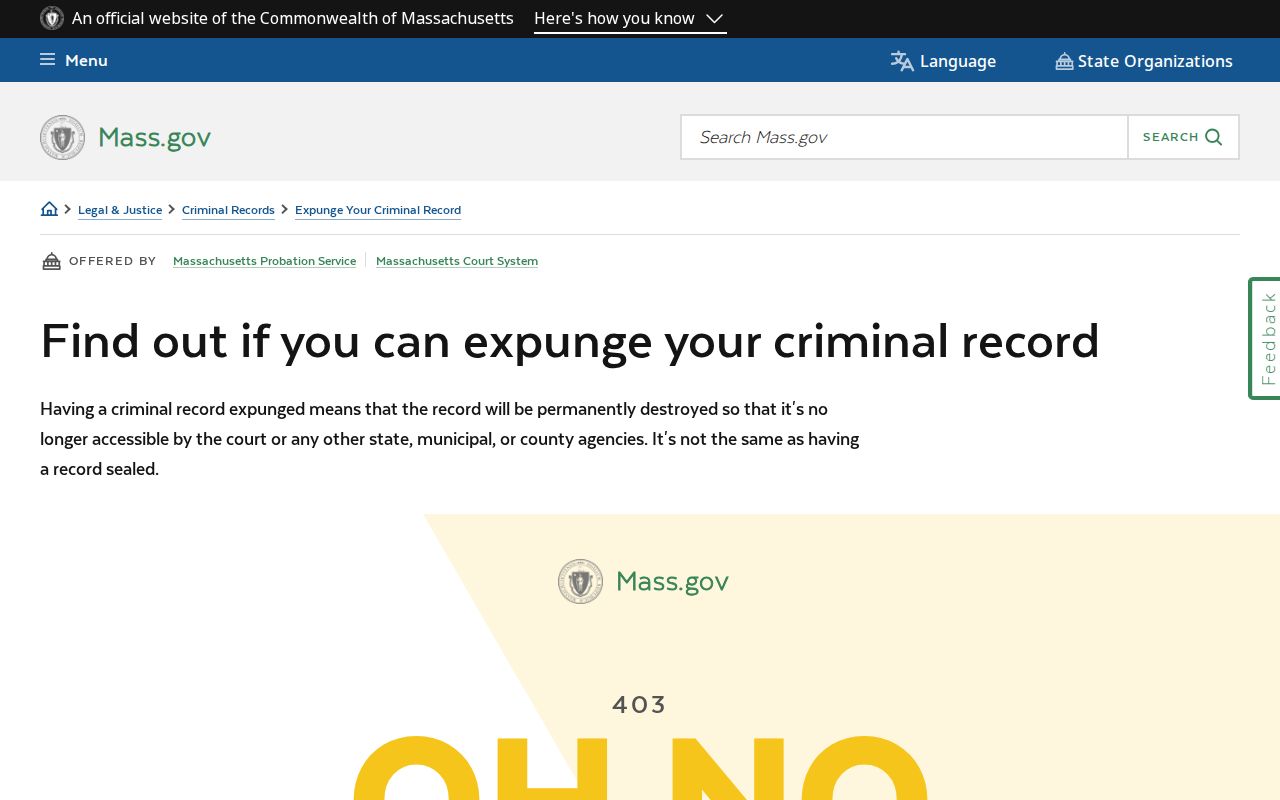
The guide is only a starting point. It is not a decision that a particular record qualifies, since eligibility turns on the case, the dates, the charge, the disposition, and statutory exclusions.
| Action | Effect on the official record | What may remain elsewhere |
|---|---|---|
| Sealing | Restricts public access under the governing law. | A sealed official record may still exist, and an independent copy may remain online. |
| Expungement | Orders covered records destroyed or erased by the responsible criminal-justice custodians. | Publisher pages, cached results, screenshots, and copied images may need separate correction. |
| Dismissal or acquittal | Changes the case outcome and may support a sealing request or rule. | A stale page may still omit the later court disposition unless corrected. |
Note: Confirm eligibility before filing, and use the current court or state form; waiting time alone does not settle every exception.
No Pay-to-Remove Law, Real Remedies
Massachusetts has no state statute creating a general anti-pay-to-remove rule for booking photos. A person still has real remedies. Start with the official record. Correct it when it is wrong. Sealing or expungement may apply if the case qualifies. Then give the publisher the exact URL. Add official proof of the changed outcome or identity error.
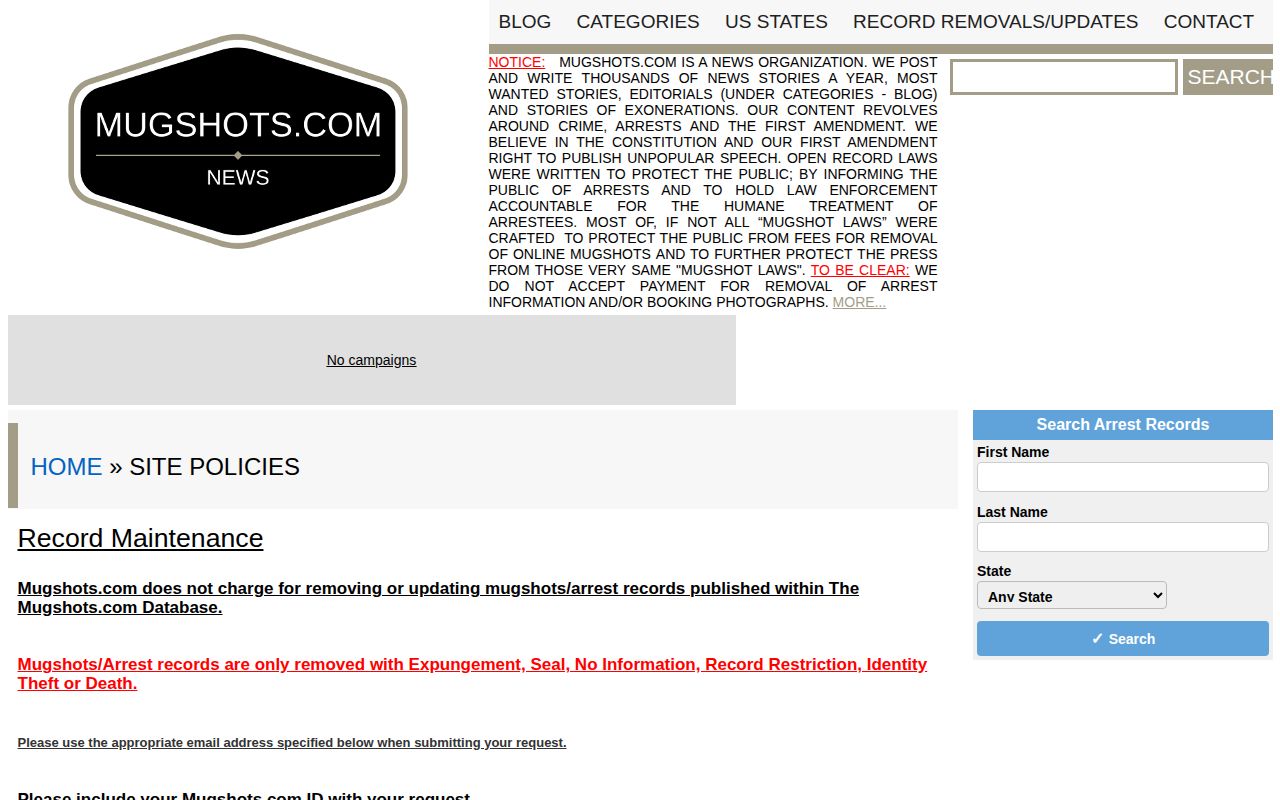
RecentlyBooked lists no county coverage or profiles on its Massachusetts-facing interface. Its no-charge correction policy accepts requests for many record types. These include dismissed, expunged, sealed, wrong-person, incorrect, outdated, juvenile, or duplicate records. It asks for the page URL and identifying details, with supporting documents when available. An empty interface proves nothing about statewide coverage. Mugshots.com lists Massachusetts county categories on its state page. Its site policy describes a no-charge route for qualifying expunged records. It also lays out a process for updates. That policy belongs to the publisher, not to any official Massachusetts record. Follow the current instructions there. Never treat a third-party page as complete, current, or controlling.
Busted Newspaper lists no Massachusetts sections. Its general correction terms do not amount to a Massachusetts-specific route. Arrests.org and Mugshots.zone list no Massachusetts sections either. Treat both the same way. Never guess a county link in place of a missing state page.
| Problem | Free first step | Useful proof |
|---|---|---|
| Wrong identity or fact | Ask the official custodian to correct its record, then contact any verified publisher with the exact page URL. | Official record, ID clarification, or written correction from the custodian. |
| Sealed or expunged record | Confirm the official action, then send the order or agency confirmation to a verified publisher. | Court order, docket entry, or agency confirmation. |
| Old court outcome missing | Ask the court or police source to confirm the disposition and update the public record where required. | Current docket or certified disposition if available. |
A news outlet may correct a factual error, though no statewide publisher promises free removal as a general rule. A correct report is not erased when a case ends. Ask the outlet to show the supported outcome. A response window is not a legal deadline.
Retention Does Not Equal Online Access
Retention and online posting are different questions. Keeping a file does not mean showing it. Massachusetts agencies follow the current Massachusetts Statewide Records Retention Schedule, dated March 2026, while cities and towns use the municipal schedule for their local police record series. Both schedules tell a custodian how long to keep an arrest record, booking log, or photo, and when it may be destroyed or transferred. No schedule promises a booking photo stays online. The state sets no single display period either. Departments can pull a mugshot early. Older records follow another route.
The Massachusetts Archives research service helps identify transferred collections and finding aids. Permanent state records may move through the Archives' process, where privacy limits, backlogs, and digitization shape access. Its holdings include historical institutional and correctional records. For a modern arrest, that archive is the wrong door, so start with the agency, clerk, sheriff, or DOC that created or holds the record.
Note: A webpage can disappear before its retention period ends, while a copied page may outlive the record it mirrors.
Check the Record and Its Outcome
A smart Massachusetts arrest search keeps four records separate. One is the arresting agency's daily log. Another is the police or booking record you request. The third is the court docket, and the fourth is whatever source shows current custody. A daily log entry shows only that an arrest was reported. A booking record can add custody details. A docket can show arraignment, bail, continuances, dismissal, trial, or sentence. A custody search shows who is in custody now. No single one of these answers every question about a Massachusetts arrest.
Use the statewide photo landscape to sort out the difference between official logs, booking portraits, and secondary publishers. For police releases, Massachusetts State Police arrest news covers a separate agency, and it is no substitute for a local booking record. If a result matters to a case, confirm it with the agency or court holding the official record.
Massachusetts law favors access to specified records. It still shields private, juvenile, investigative, and sealed information. Not every arrest file or photo becomes public. The sound path is to request the narrow official record, read its limits, check the docket for the outcome, and use the documented correction routes if later facts change things.