
Massachusetts Arrests Have No State Feed
Massachusetts publishes no single feed gathering every county booking from the past day, and no statewide photo roster exists. Same-day arrest information lives with municipal police departments. Boston, Cambridge, Pittsfield, New Bedford, Springfield-area cities, and other municipalities each post logs, press entries, or dated files. Formats vary. One department covers calls for service. Another lists only arrest activity. Neither runs on a shared clock. That split frustrates anyone searching Massachusetts arrests after word spreads that a person was taken into custody. The first public entry usually comes from the city. The county sheriff may hold the person later. A log without a booking photo is still the official public record of police activity, though it can leave out a protected incident entirely. A missing name points to a different agency, a delayed post, or a record that cannot be published. It never proves no arrest happened.
Find the Arresting Agency First
Begin where the arrest happened. Massachusetts splits its law enforcement among municipal police, sheriffs who run the houses of correction, and the State Police. No single live booking list covers all of them. So a statewide name search usually dead-ends fast. The County Directory solves that. It routes you to the locality's own records, so you can name the right police department or sheriff before assuming anything is statewide.
Keep a same-day search tight. Pull up the department's public log or press-log page first. Read the date label before you open an entry. PDFs deserve extra care, since a search engine may index them weeks late; trust the period the agency itself stamped on the file. Some departments post no log at all. In that case, go straight to the records office of the arresting agency. A county roster can still help with custody questions, though it may miss someone who was just booked, cited, released, or moved.
What if the log is stale? Try an official live custody page if the county runs one. Still nothing? Call the records line. Then send a written request for the dated log or the arrest record itself. That step-by-step fallback pins down which custodian actually holds the booking, without pretending every county shares the same feed.
- Identify the city or town where the arrest likely occurred, then note the relevant county or state-police area.
- Open that locality's official police or sheriff source and look for its own daily log, arrest page, or dated PDF.
- Compare the incident period with the publication date, and check whether the source covers calls, arrests, bookings, or current custody.
- If the entry is missing or custody is still unclear, contact the arresting agency's records unit and request the dated log or record.
Note: Local police logs and sheriff custody pages answer different questions, even when they concern the same event and person.
What Massachusetts Same-Day Logs Show
Massachusetts law gives the public a basic route into municipal police activity. M.G.L. c. 41, § 98F governs the daily log. It covers calls for service and complaints. Names, addresses, and charges of arrested people appear there. Sensitive incidents and people under 18 stay in a separate nonpublic log. The public log is not the full arrest packet, and the statute requires no portrait gallery.
| Log detail | What it can tell you | What it cannot prove |
|---|---|---|
| Covered period | The date or span the agency says the log records. | That every event from the period is already posted. |
| Name and charge | Who police reported arresting or charging, when that field is public. | That the charge was proven or remained unchanged. |
| Place or call type | Where police activity was logged and its broad type. | That the entry is a jail booking rather than a call or other response. |
| Post or print date | When a page or file was made available to readers. | When the arrest took place. |
| Photo | Whether that agency chose to publish a portrait in that source. | That a missing photo means no booking image exists. |
Cambridge Police posts its log by calendar day. The dated daily-log example shows that municipal format. It is a city record, not a Middlesex County jail roster. The daily log may be free under the statute, while other report copies take a separate public-records request.
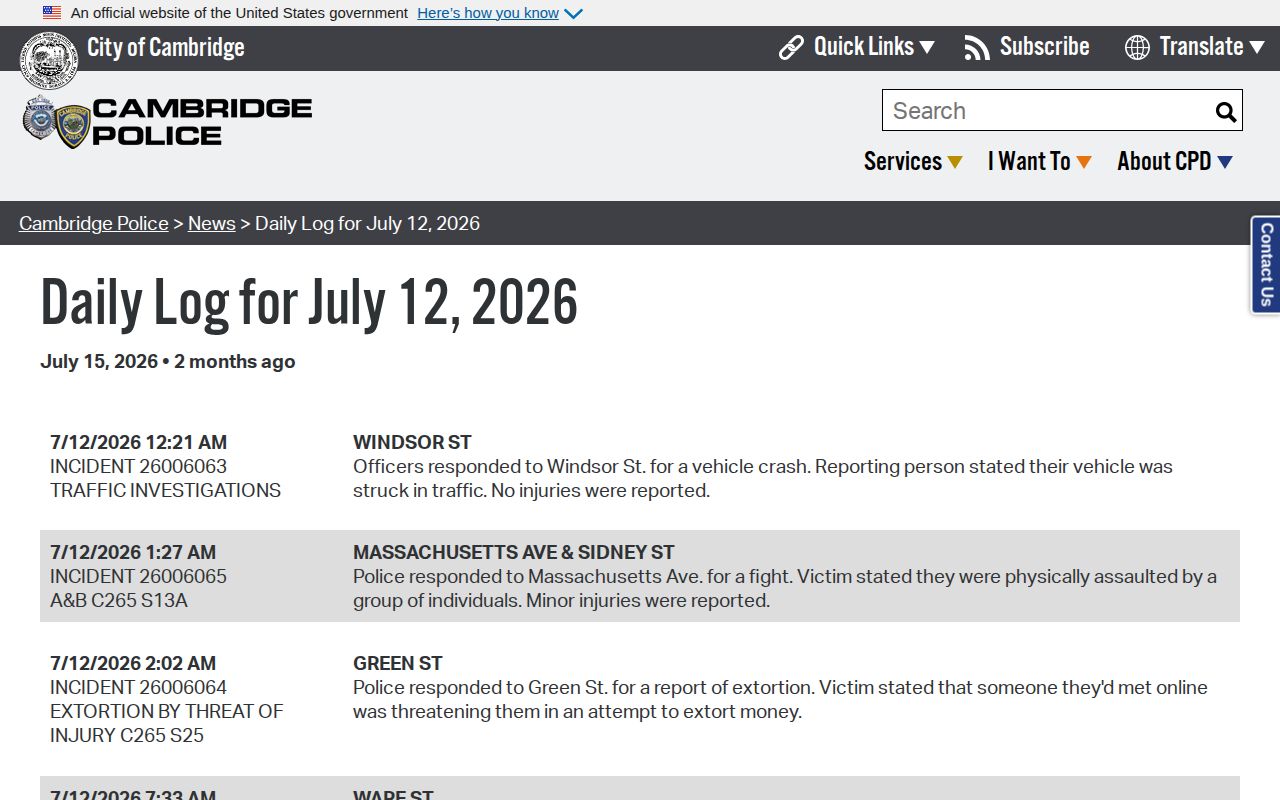
The source's label matters: this is a city log, not a county roster.
Massachusetts Same-Day Arrest Sources
Massachusetts municipal logs vary by agency. They also vary by date window and record type. These official samples are not a ranking or a full county list. Most are text or PDF files. Booking photos are not routine. Keep the source name and its own period with each record.
| Official example | Published view | Scope limit |
|---|---|---|
| Barnstable Police | Dated daily public-log PDFs. | The PDF date and online post date can differ; no routine portraits were observed. |
| Pittsfield Police | Press-log PDFs with dated entries. | A municipal press log is not a Berkshire County custody feed. |
| New Bedford Police | Daily arrest-status PDFs and police-log material. | It describes city police activity, not every Bristol County booking. |
| Chicopee Police | Arrest-log archive, alongside a separate daily log. | Different records can cover arrests and broader daily activity. |
| Plymouth Police | Online logs posted weekly when possible. | Not a guaranteed live or 24-hour feed. |
Barnstable's official page links to its dated files. The daily-log listing shows the agency's PDF structure before you open a record.
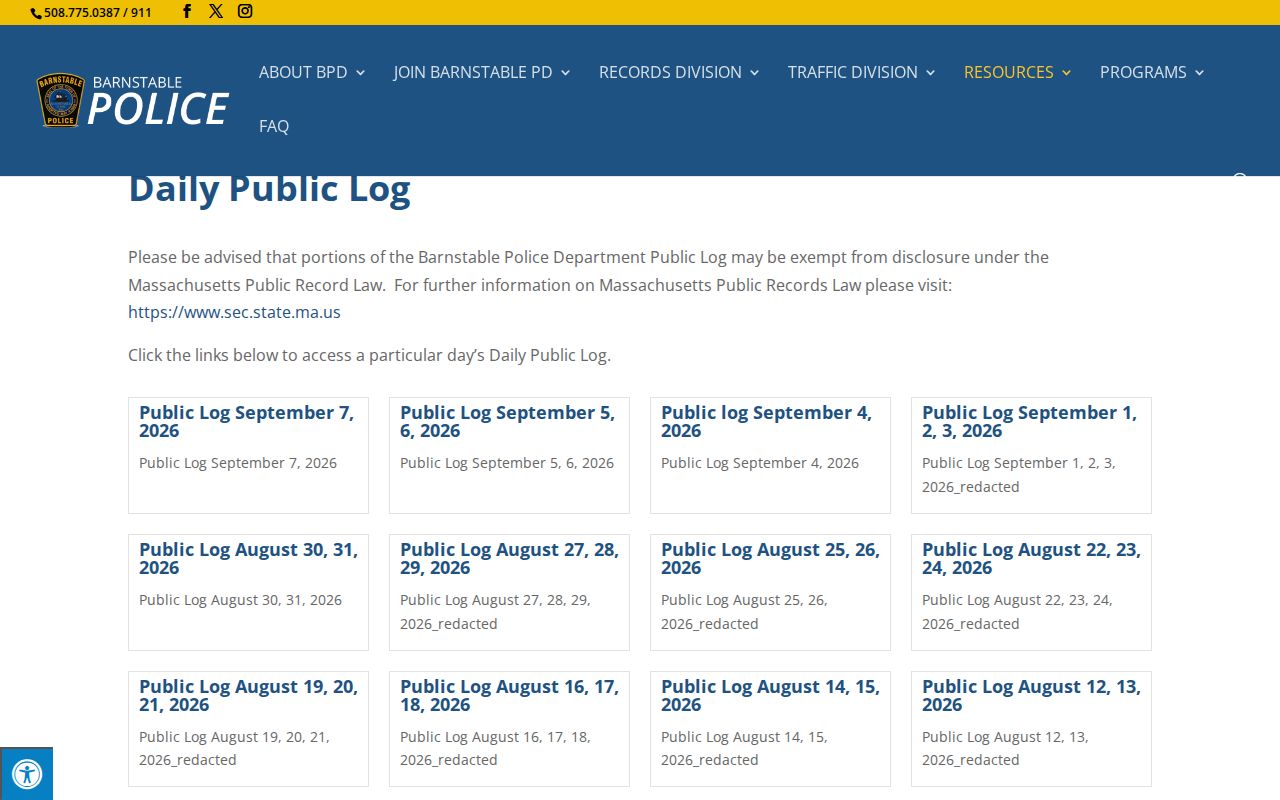
A dated file is a municipal source. Keep the agency name and the printed time span with it. New Bedford's police-log page follows another pattern. Its text and PDF arrest-status files are municipal records, not a Bristol County booking system.
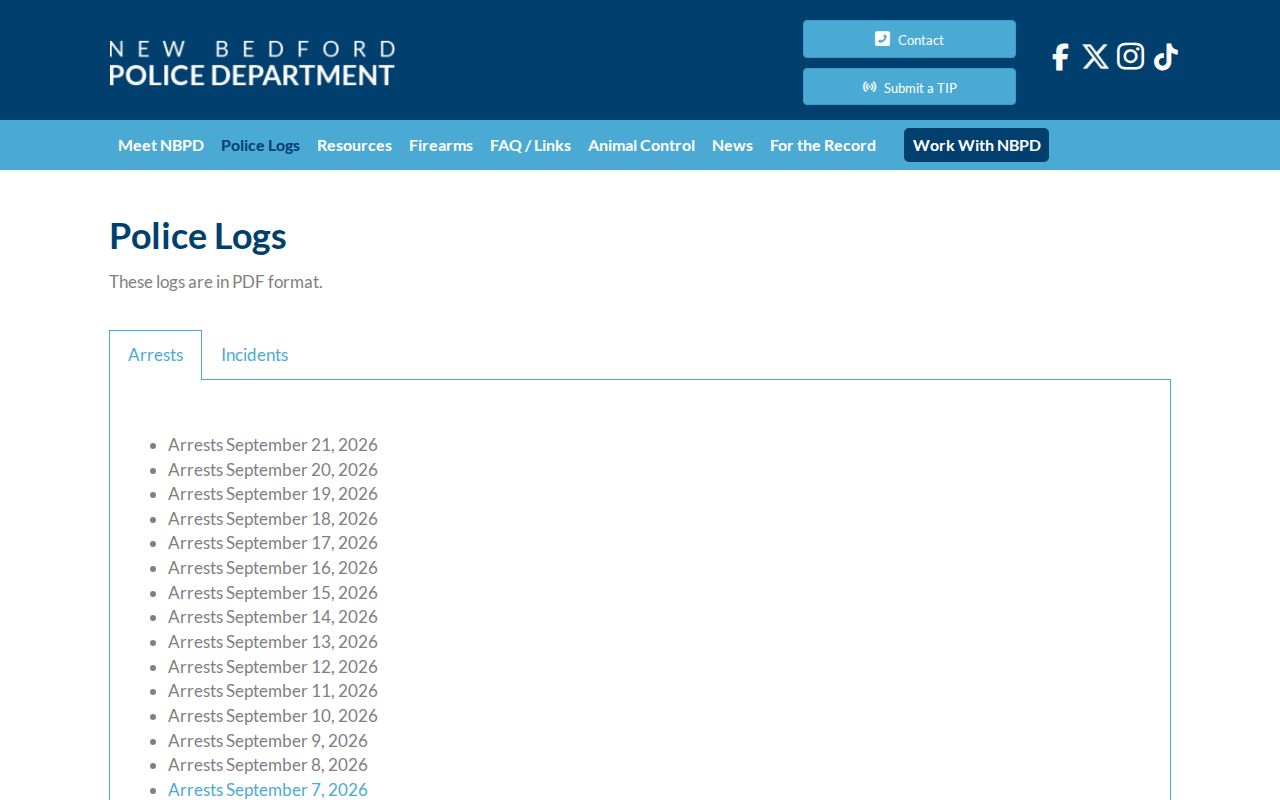
City arrest logs stay separate from the county jail roster, even after a sheriff takes custody.
Date and Posting Time Can Differ
The word "today" causes more confusion on arrest logs than any other. It can point to when an incident happened. It can also mark the span a log covers. Or it may name the moment a file went up. Those are different things. A Barnstable public-log PDF covering April 4–5, 2025 was printed on April 8. Pittsfield followed the same pattern. A log dated September 9 came off the printer on September 10. So an official page can look current the second you open it. Yet every entry inside describes an earlier window. The Pittsfield press-log archive labels both dates plainly, which helps. Note the event date and the print date separately, and never treat a delayed file as a same-day arrest list.
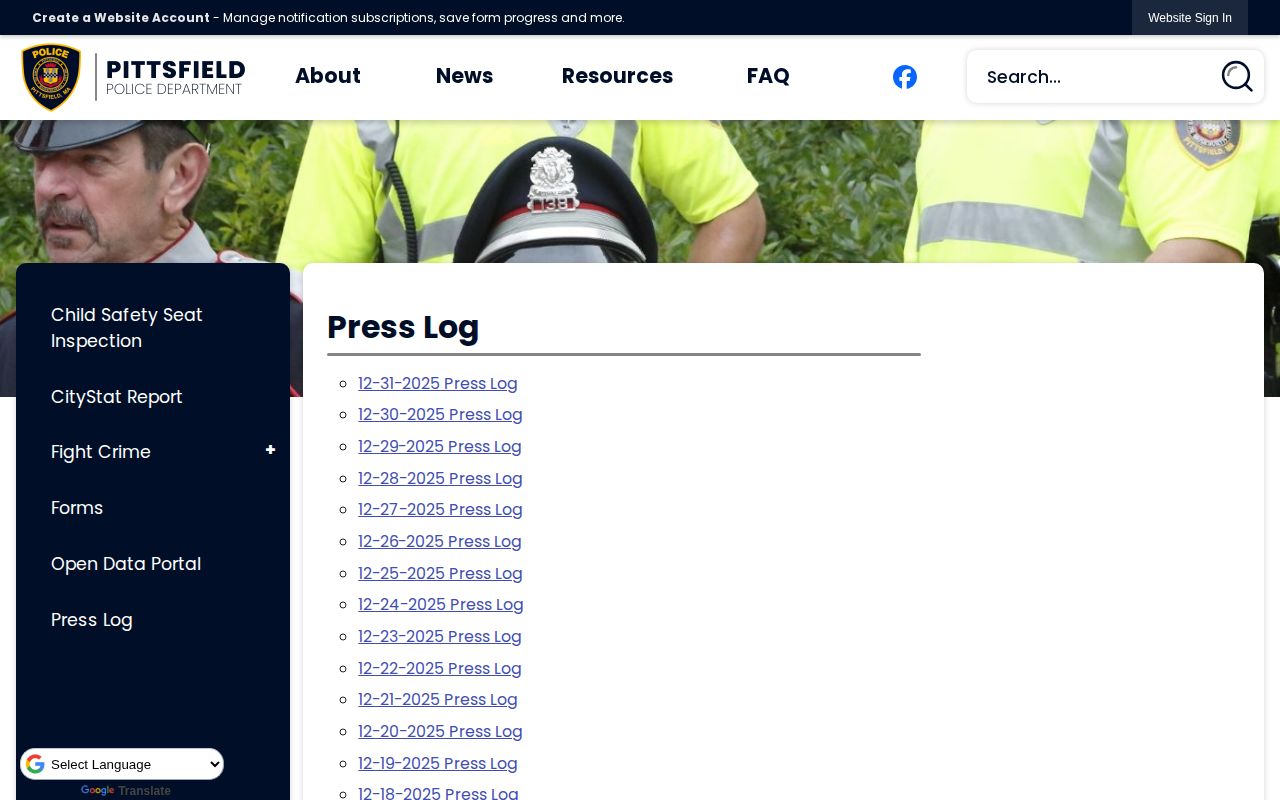
Cambridge waits until a covered period closes before posting its calendar-day log. Northampton runs further behind. Its official police resource carried a January 16, 2026 incident. The PDF was printed March 2, 2026. Treat publication as availability, not as a live booking alert.
A log posted today does not confirm an arrest today. The post date only marks when the file became public; the event date and covered period mark when the underlying activity occurred. When timing matters, go back to the arresting agency for the answer.
Note: Save both incident and publication dates when they appear; each describes a different point in the record's path.
Massachusetts Custody Pages vs Arrest Logs
An arrest log and a custody page answer different questions. One tracks police activity. The other shows who is held right now. Massachusetts county systems publish a mix of the two. The Worcester County Sheriff's inmate search returns an inmate number, name, date of birth, and block or cell. A details view offers more. It displays no booking photo, and the office states no posting schedule or lag policy. So it is a current-custody lookup. It is not a full record of Worcester County arrests in any 24-hour span.
The gap is easy to miss. A person can be arrested and released before the custody page ever changes. Someone may be booked through a different local process, or held by another agency entirely. A booking record and a custody status are separate records. State prison adds one more layer. A DOC search covers people housed in state facilities, not a county feed. The official Massachusetts DOC search instructions walk through the state prison lookup route. A missing county result there proves nothing about whether an arrest happened.
Verify a Massachusetts Arrest Record
An online log may come up empty or thin. When that happens, ask the agency that created the record. Write to the police department's records access officer. Identify the person if known, and the likely date. Add the town or incident, and the record wanted, such as a daily log or an arrest report. The Massachusetts public-records process asks for a reasonable description and a preferred format. No magic phrase is required. The Secretary of the Commonwealth's public-records guidance spells out response, fee, and appeal rules.
Expect the first written response within ten business days. Statutory extensions can stretch that clock. A municipal daily log under c. 41, § 98F comes free of charge. Other records may carry reasonable fees for search, redaction, segregation, or copies. An agency can redact protected details or withhold material under a public-records exemption. A response can be denied or fall short. The Supervisor of Records appeal route in the state guidance is the next step.
Start narrow. One dated log or incident is far easier to route than an all-state arrest database. Massachusetts does not maintain that as a public county-booking feed. For wider multi-day sources and their archive limits, see the Police Blotter overview.
Note: If a record is not online, the arresting agency remains the first source for its log, report, and any later correction.