
Search Massachusetts Recent Arrests
Massachusetts has no single public roster that gathers every county booking or municipal arrest. A town police department may publish a daily log. A sheriff may offer a current-custody search. The Massachusetts State Police may issue a press release about a major case or enforcement operation. Each system answers a different question. A log describes police activity. A custody search shows who is held right now. A press release highlights selected events. None of them adds up to a complete state list of everyone arrested.
Any recent-arrest entry reflects what one agency reported at one moment. A person can be released before a web page updates, and a charge can change as a case moves through court. Treat Massachusetts recent arrests as a starting point, then verify with the agency or court that holds the actual record. Pay attention to the source's date, scope, and labels before drawing any conclusion from a name or booking charge.
Route an Arrest by County
Start with the municipality where the arrest took place. Then figure out which agency made it. County borders in Massachusetts do not create a uniform booking network. Local police logs stay organized by department. Sheriff custody systems cover people held in a county jail or house of correction. A county seat is a directory aid, nothing more. It does not prove an arrest or booking happened there.
Use the Massachusetts County Directory from the navigation. It opens the local site for the likely arrest county. Each county site routes visitors to its own roster, log, and city coverage. If the arresting agency is unclear, begin with the town police department named in a court notice or public report. A quick call can help. It can sort a local log from a sheriff's custody record.
The state's 14 county folders span large multi-city areas, island communities, and Nantucket's single-municipality county. That means a search in Boston, Cambridge, Springfield, or Worcester starts with different local publishers. The directory keeps those routes separate. It does not merge them into a false statewide count.
Note: The county seat is a geographic label and does not identify the jail, booking office, or court for every arrest.
Same-Day Arrests in Massachusetts
Research across all 14 counties did not verify a uniform statewide or countywide same-day booking-photo feed. Some city departments publish daily or near-daily logs, but the covered window may follow a calendar date, a print date, or a period chosen by that agency. A page posted today may describe an earlier incident. Most reviewed municipal logs were text or PDF records without a routine booking portrait.
Does a missing log entry mean no arrest happened? No. The log may not be posted yet, may cover a different period, or may omit a protected entry. Confirm with the arresting agency before treating a blank page as a result.
| Window | Statewide picture | Page route |
|---|---|---|
| Same-day official logs | Municipal logs and dated files use different periods and posting times; no complete state feed was verified. | Arrests Last 24 Hours |
| Multi-day blotters | Weekly, monthly, or older archives preserve local activity but do not show current custody or every arrest. | Police Blotter |
For a fresh booking, check the arresting town's log first. Then try the county custodian likely to hold the person. Results can lag court and transfer steps. If the first search has no match, contact the records office for the source agency. A missing page is not proof. It does not mean no arrest happened.
Multi-Day Arrest Logs
Longer arrest logs are archives, not live custody lists. A municipal page may retain daily PDFs or organize crime statistics from Monday through Sunday. A sheriff lookup, by contrast, may only show a person still in custody. Both kinds of pages help. Their dates and purposes should stay distinct.
Massachusetts examples range widely. Chelsea keeps a weekly crime-statistic archive, and Leominster keeps a monthly municipal one. Other towns post dated police PDFs. Plymouth Police describes its online logs as weekly postings when possible. Those examples show why a multi-day blotter should state its covered dates. Its posting pattern matters too. It should not label a recent page as all arrests. Older or missing entries may take a targeted request or archive search. The Police Blotter route in the window table compares those broader periods with current custody.
State Police releases belong in this reading path only as selected news. Historical arrest-detail files cover an older, bounded period. They should never stand in for a live municipal log. Anyone seeking a past event should keep the agency's own date labels. Request the exact record type.
Official Channels for Arrest Records
Start with the office that actually holds the record. A town police log answers one kind of arrest search. A sheriff's lookup answers who is in custody right now. Court dockets follow the case itself, while the DOC search tracks state-prison custody. Match the question to the channel. Then confirm the arrest record with that source.
| Official source | Best use | Important boundary |
|---|---|---|
| Local police daily log | Basic dated police activity and eligible adult arrest entries | Protected categories and investigations may be withheld; it is not a full report |
| County sheriff custody search | Current custody in that county system | Released people can drop from the current list |
| Massachusetts State Police news | Selected state-level cases and enforcement announcements | Not a statewide daily arrest feed |
| MassCourts and court clerks | Case events, hearing entries, and disposition when available | Search fields and online coverage vary; the docket is not a booking-photo source |
| DOC offender search | State-prison custody and status | Not a county jail roster or arrest history |
A statewide arrest search works best when you trace each event straight to the office that holds the record.
- Start with the town, city, or place tied to the arrest and identify the police agency that handled it.
- Read that agency's dated public log or press page; keep the event period and post date separate.
- If current custody matters, ask which county or local office holds the person and use that office's own lookup.
- Check the court docket for arraignment and later case events; a docket is not a booking record.
- If a page omits the needed detail, request the exact log, booking entry, or report from its custodian.
M.G.L. c. 41, § 98F governs municipal daily logs. The law keeps certain categories nonpublic. It shields sensitive matters such as specified domestic-violence and sexual-assault responses. It also protects entries involving anyone under 18. The Massachusetts daily-log statute spells out which entries a town must publish and which stay private.
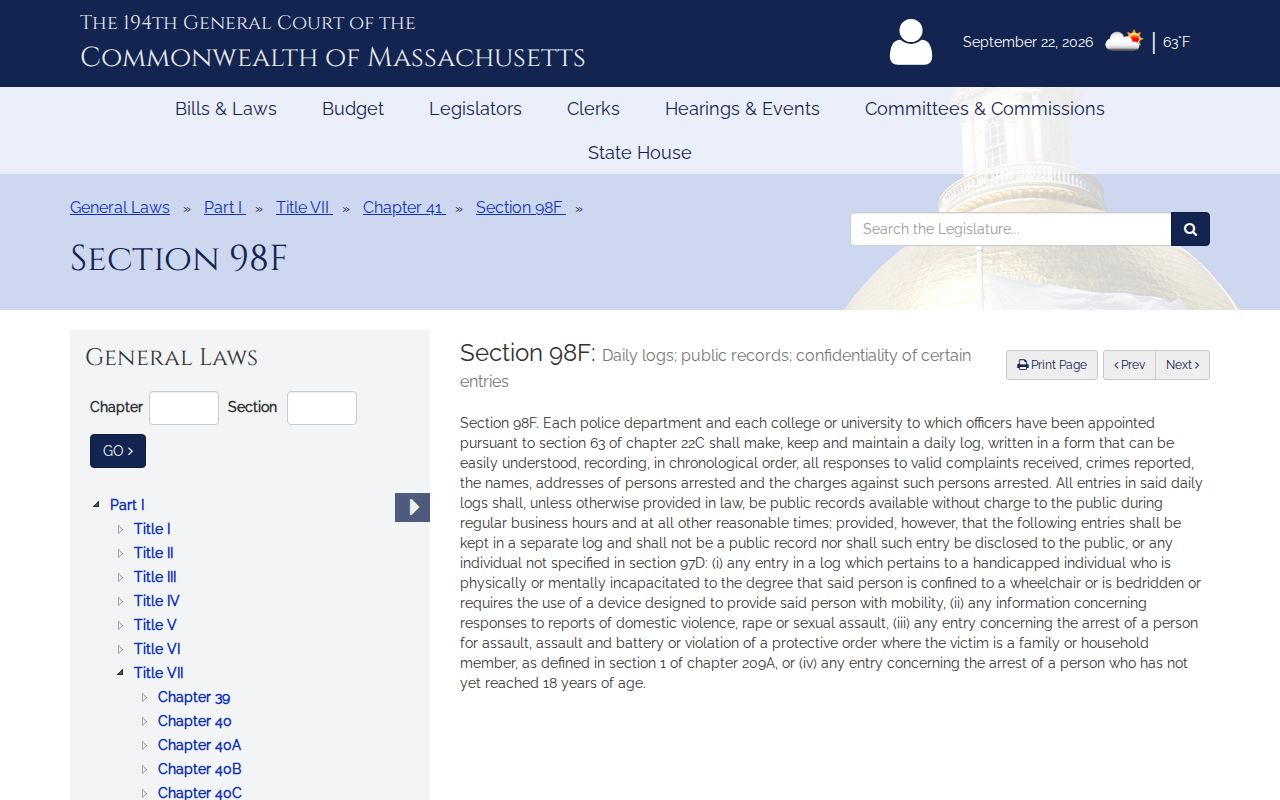
That rule explains why a department can post a short entry while withholding a victim detail or an active investigative record. The public log has limits built in.
What Massachusetts Booking Records Show
No single booking form covers every Massachusetts county. A police daily log, a sheriff's current-custody search, a booking record held by a correctional agency, and a court docket each capture a different stage of the same arrest. Each system shows different fields. A local record can list more or less. Agencies may also redact protected details before release.
| Record layer | Fields or details reported | What it means |
|---|---|---|
| Municipal police daily log | Incident date, location, name, charge or arrest-type entry | A basic public chronological record, subject to statutory limits |
| Worcester County Sheriff current-custody lookup | Inmate number, name, date of birth, block, cell, details | A live custody view in one county system, not a statewide booking form |
| MassCourts docket | Party, case, event, and disposition fields for searchable case types | A court timeline, not proof that an charge is true |
| DOC / VINE result | Search by full first and last name or commitment number; custody/status result | A state-prison custody tool, not a municipal arrest feed |
The Worcester County Sheriff's inmate lookup shows the kind of limited current-custody fields a local system may use. The page displays field labels only. It sets no statewide standard, and Massachusetts sheriffs do not all run the same search.
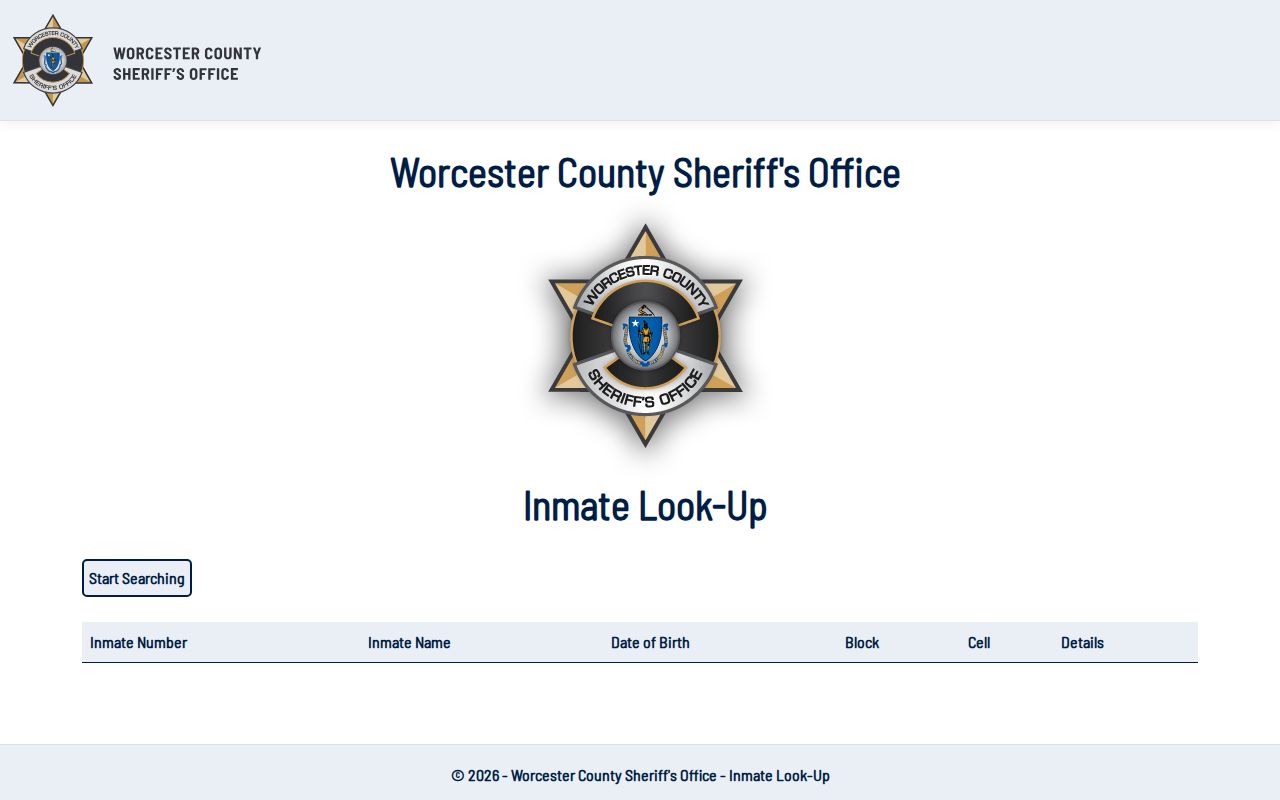
A current roster can drop a person after release or transfer. The arrest log and court docket still exist. For an older event, ask the custodian for the historic booking record.
Record terms: Booking is the step that follows arrest. Arraignment is an early court hearing. Bond is a release condition or payment set by a court. Disposition is the court's result. Sealing limits public access, while expungement removes covered records under the law.
Massachusetts Mugshots and Photos
Massachusetts has no statewide rule forcing agencies to post a booking photograph online. Most municipal logs are text or PDF documents. They rarely show a booking-photo field. Sheriffs and towns also run separate systems, not one statewide image feed. A booking photo may sit in an agency file. It can stay there without ever appearing on its public page.
| Channel | Source status | Photo and record limit |
|---|---|---|
| Municipal daily log | Yes, when posted by the police department. | Usually text or PDF in reviewed examples; a missing image says nothing about whether the agency holds one. |
| Sheriff custody lookup | Yes, for the named county system. | May show current custody fields; not a statewide arrest list or a uniform photo source. |
| State and court records | Yes, for records those offices publish. | News releases and dockets have separate purposes; neither is a complete photo roster. |
| Third-party index | No; it is an independent publisher. | May display copied images or labels that are old, incomplete, or mismatched. |
| News report | No; it is reporting, not a booking system. | Can add context to a selected case but does not confirm current custody. |
Keep three questions apart. Did police take a photo, and must the custodian release that image? Did an outside publisher copy it? A public arrest-log entry does not make a portrait public. The 2020 Massachusetts high-court decision rejected a blanket rule. That rule said CORI made every requested booking image exempt. It did not open all photographs either. The image question still turns on the record, privacy interests, and the public-interest balance.
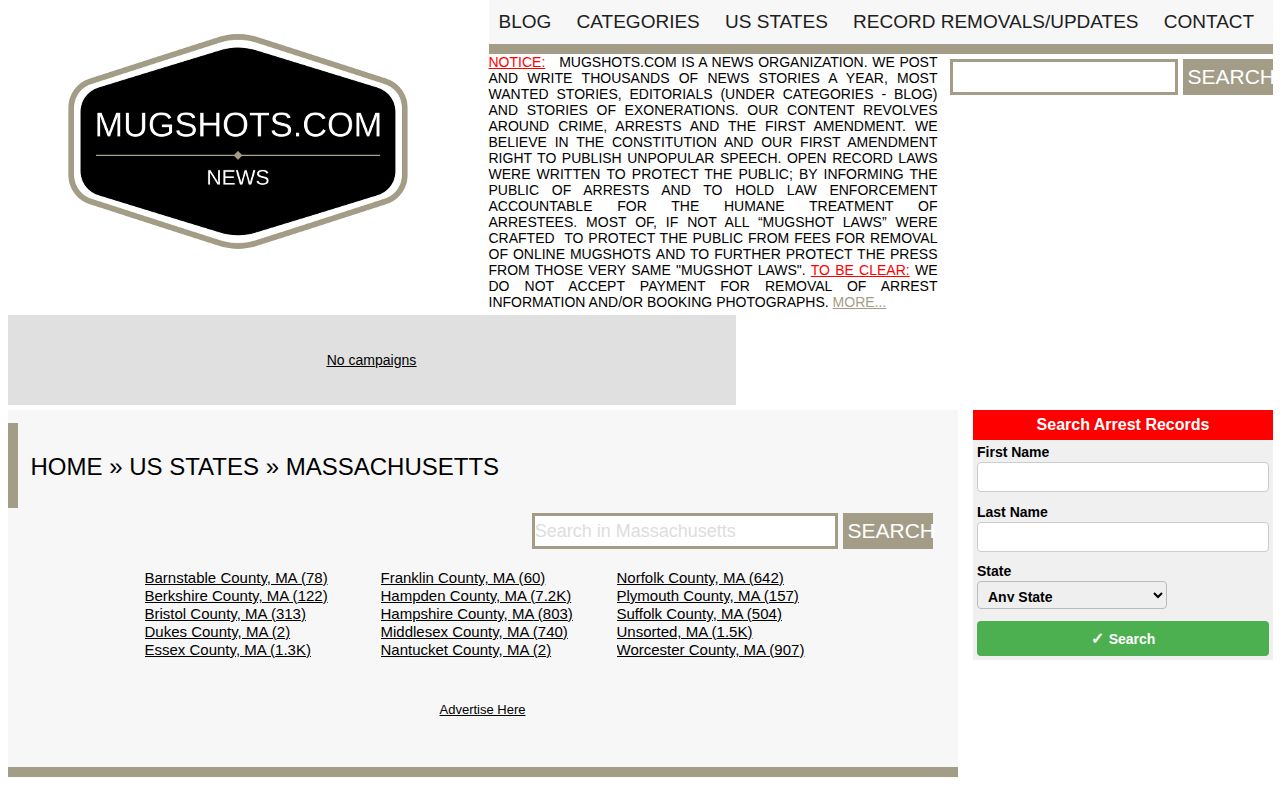
The unofficial Mugshots.com Massachusetts landing page lists county sections. It is not a government source. Labels, images, and counts may be stale or incomplete. The site helps explain the third-party landscape. The originating police department or sheriff remains the place to confirm the underlying arrest record.
The RecentlyBooked's Massachusetts interface can load with an empty county filter and no profiles. That does not mean no arrests occurred or that the service is complete. Busted Newspaper, Arrests.org, and Mugshots.zone also run Massachusetts sections with the same limits. News reports add context to selected cases. They are not custody results. Check any reported arrest against an official log or docket.
Correction options differ by publisher. Mugshots.com describes its own policy and correction route, and RecentlyBooked publishes a no-charge correction policy. Neither publisher controls a police record or court disposition. Neither promises every page will come down.
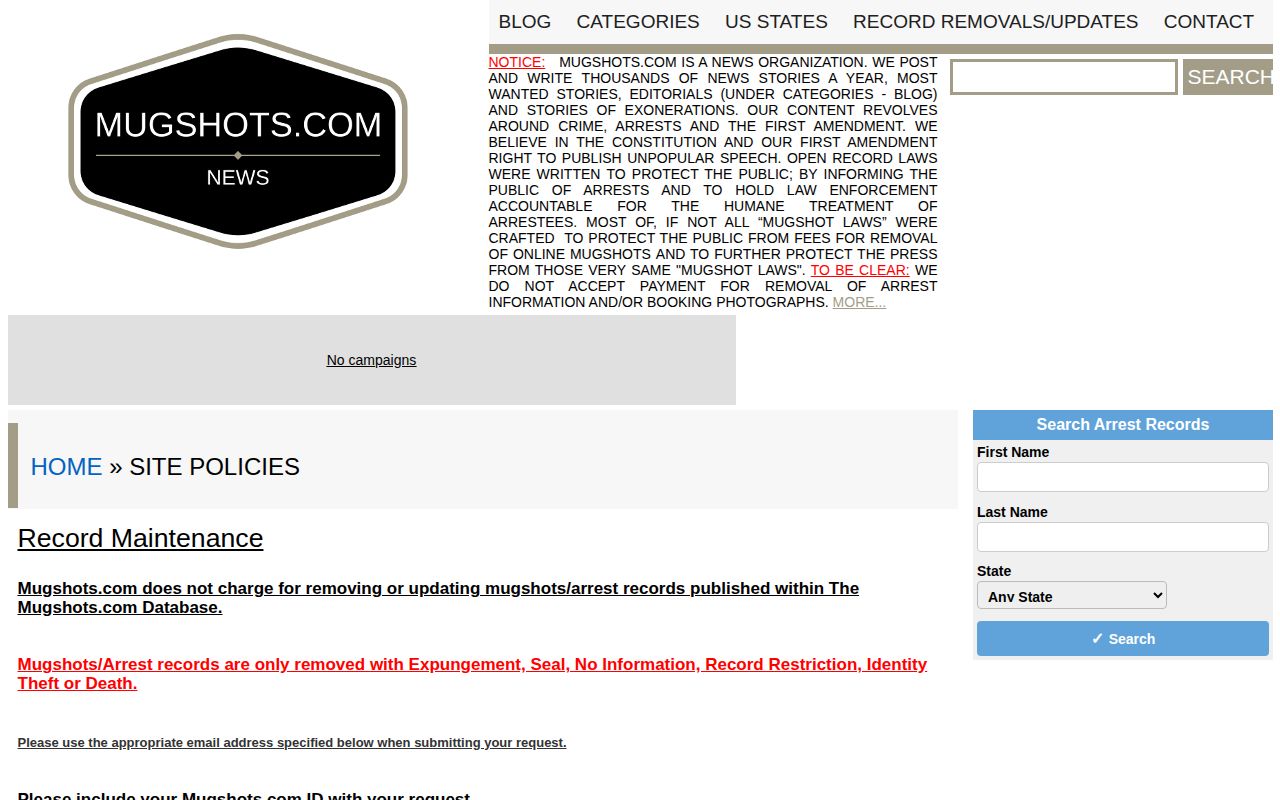
Note: A photo copied by a third party can stay online after the source record changes, so use official documents to seek a correction.
Request a Massachusetts Arrest Record
Send a Massachusetts public-records request to the agency holding the record. There is no statewide county-booking database to search as one file. A town police department holds the daily log and incident report. The sheriff may hold a custody or booking record. The State Police Public Records Unit holds many MSP reports. The court clerk controls the docket. Name the agency and record type in the request.
No special phrase or form is needed. A written request should describe the record and preferred format under Massachusetts public-records law. The agency generally answers within 10 business days, with allowed extensions. Fees must be reasonable and tied to permitted work. Agencies may redact or withhold protected material.
- Identify the arresting agency and the likely county custodian. A town log and a sheriff booking record are separate files.
- State the date, approximate location, person or case identifier if known, and exact record type, such as daily log, incident report, booking entry, or photo.
- Ask for an electronic copy or another usable format. A date range can help, but a broad request for every arrest or photograph is harder to locate and review.
- Read the response for any fee estimate, redaction, denial reason, or extension. Narrow the request if a particular report is the only record needed.
- If an access dispute remains, use the appeal path through the Supervisor of Records or seek judicial review where appropriate.
The free daily-log rule stops at the log. Investigative detail, victim information, and a booking photo can all be withheld. This can happen even when the entry is public. Fees and appeal rights fill out the rest of the picture. The state law page explains the request exemptions and court review in greater depth.
Massachusetts Rules for Mugshots and Records
Massachusetts statute creates no general right to publish booking photos. Nor does the state bar pay-to-remove schemes by name. Photo release instead sits inside the broader public-records framework: CORI rules, privacy exemptions, juvenile confidentiality, sealing and expungement law, and case-by-case court review all shape the answer. M.G.L. c. 6, § 172(m) treats police daily logs, arrest registers, and chronological arrest records as public records. Separate identity-taking provisions explain why police may photograph some felony arrests. Those provisions do not compel posting the photo online.
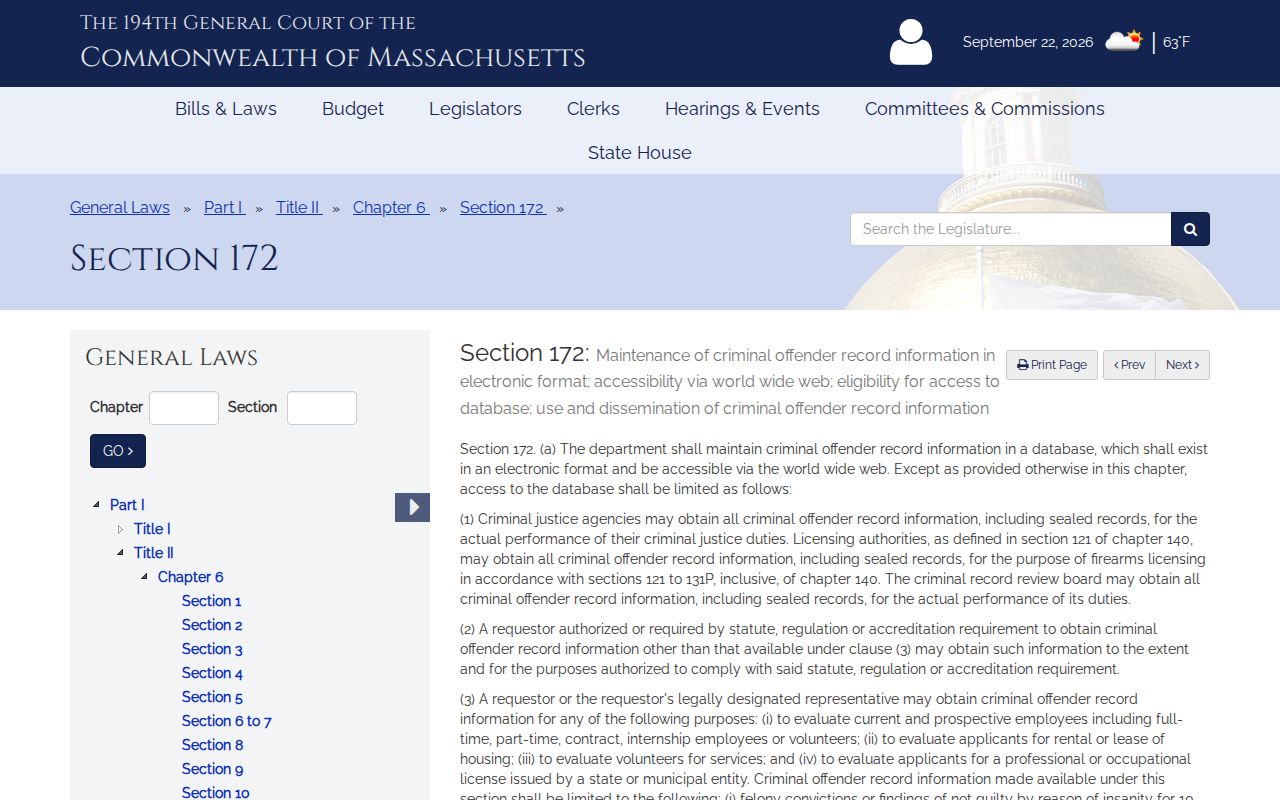
The 2020 Boston Globe Media Partners, LLC v. Boston Police Department opinion refused to treat CORI as a categorical bar to booking photos of arrested public officials. It did not order release of every portrait either. Each agency still weighs the record, privacy interests, public interest, and exemptions. The detailed state-law page explains that balance.
Access has boundaries. CORI alone makes nothing automatically public or private. Juvenile records, protected victims and witnesses, and active investigative material can all be restricted. Ask the custodian for a dated log or a specific record. Let the agency apply any valid redaction.
Note: A public arrest register and a booking photograph are separate record questions under Massachusetts law.
Massachusetts Warrants and Wanted Lists
Massachusetts runs several official wanted-list systems. There is no single statewide real-time warrant database open to the public. A wanted profile is a law-enforcement notice, not the full warrant file. A missing name proves nothing either way. Someone listed may already be in custody, or the profile may be stale.
The official lists cover distinct custody worlds:
- Massachusetts State Police Most Wanted profiles serious or violent fugitives and directs tips to the Violent Fugitive Apprehension Section.
- Department of Correction Most Wanted concerns state-prison escapes and absconding, not county arrest warrants.
- U.S. Marshals Service profiles concern federal fugitive matters and have their own jurisdiction and tip path.
For a personal warrant or court-status question, call the issuing agency or clerk. An attorney can help too. Never treat a commercial search result as the current court record. If a profile asks for tips, use the listed law-enforcement channel. Skip the comment thread or social post.
Important: Never approach, follow, contact, or confront a wanted person. Use the official tip line; call 911 for an immediate threat.
The official State Police wanted page posts serious and violent fugitive profiles. It also lists the agency's tip route.
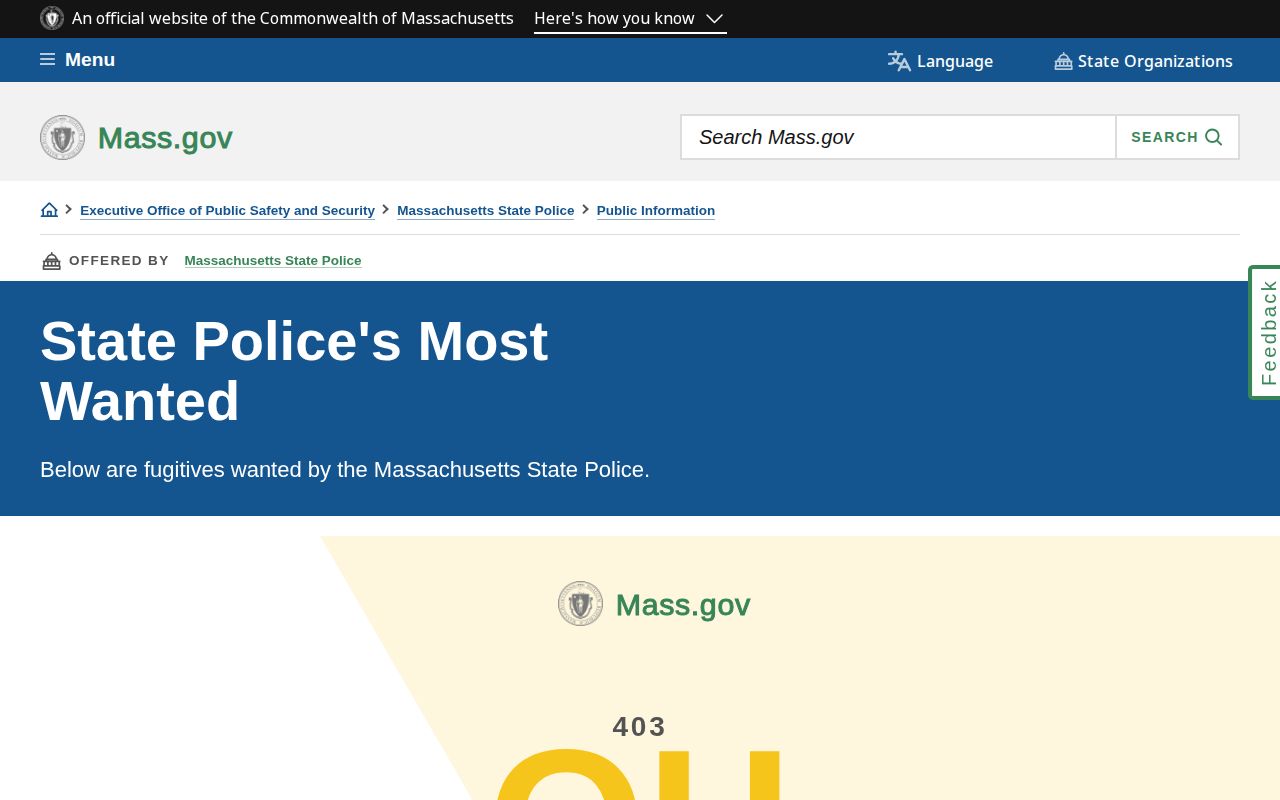
Keep the profiles separate. MSP, DOC, and federal marshals publish no combined Massachusetts warrant roster.
After a Massachusetts Arrest
An arrest in Massachusetts can go several ways. The person may be booked, released, brought to court, or held while a case moves forward. Each system records a different piece. The booking record documents processing at the station. A police log records an event. The docket records court steps. A release from custody drops a name from a current roster without erasing the historical log or court entry. A sentenced person in state prison belongs in a DOC custody search, not a county booking list. A State Police arrest does not mean state-prison custody either; depending on place and custody order, the person may be booked through a local or county custodian.
| Record state | What it can mean | What it does not settle |
|---|---|---|
| Booked or held | An agency recorded intake or current custody in its system. | The charge is proven or the same office holds the person later. |
| Released | The person is no longer held in that custody system at the time shown. | The arrest log or court case has disappeared or ended. |
| Sentenced to state prison | DOC custody may be the current record layer. | A DOC result is a county booking record or full arrest history. |
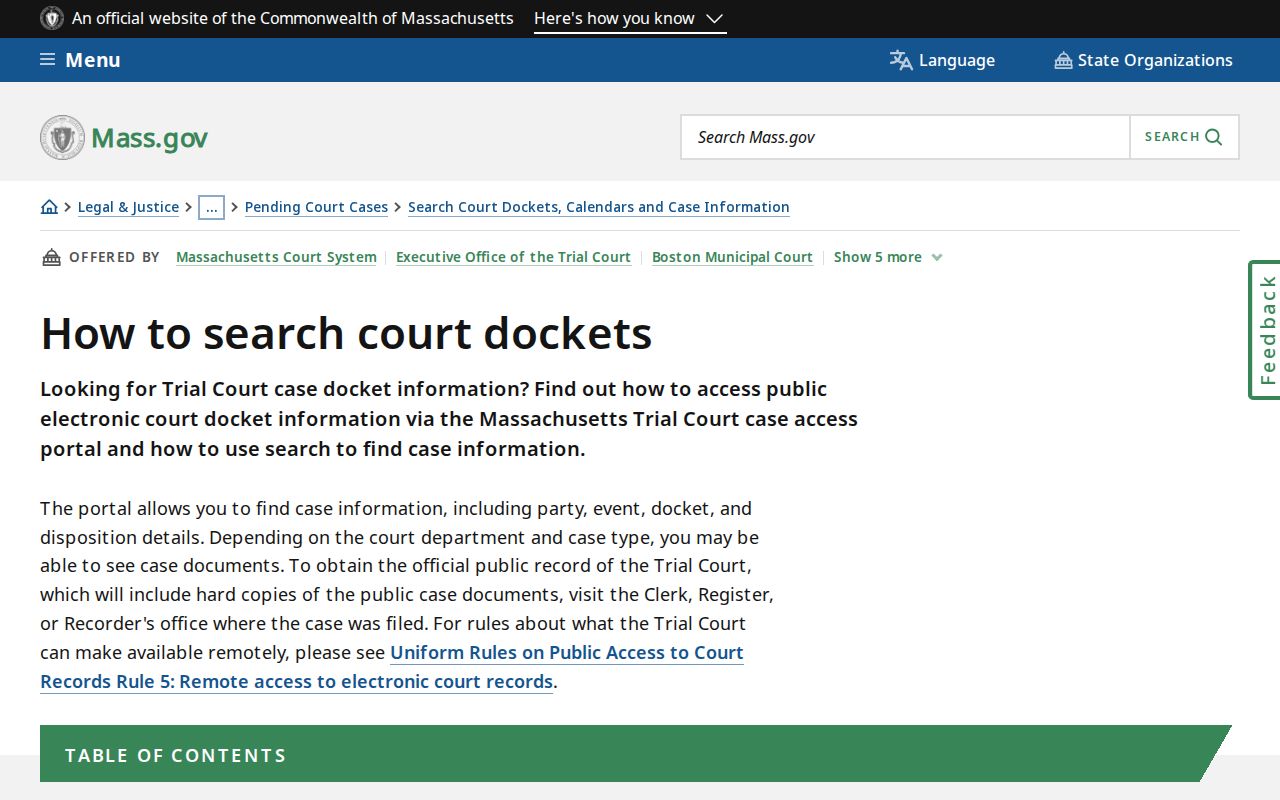
Massachusetts court docket instructions spell out the public search limits. MassCourts may show party, case, event, and disposition details for covered case types. Some matters still need a docket number or clerk help. A docket entry is not a police narrative. An online result is not a certified court file.
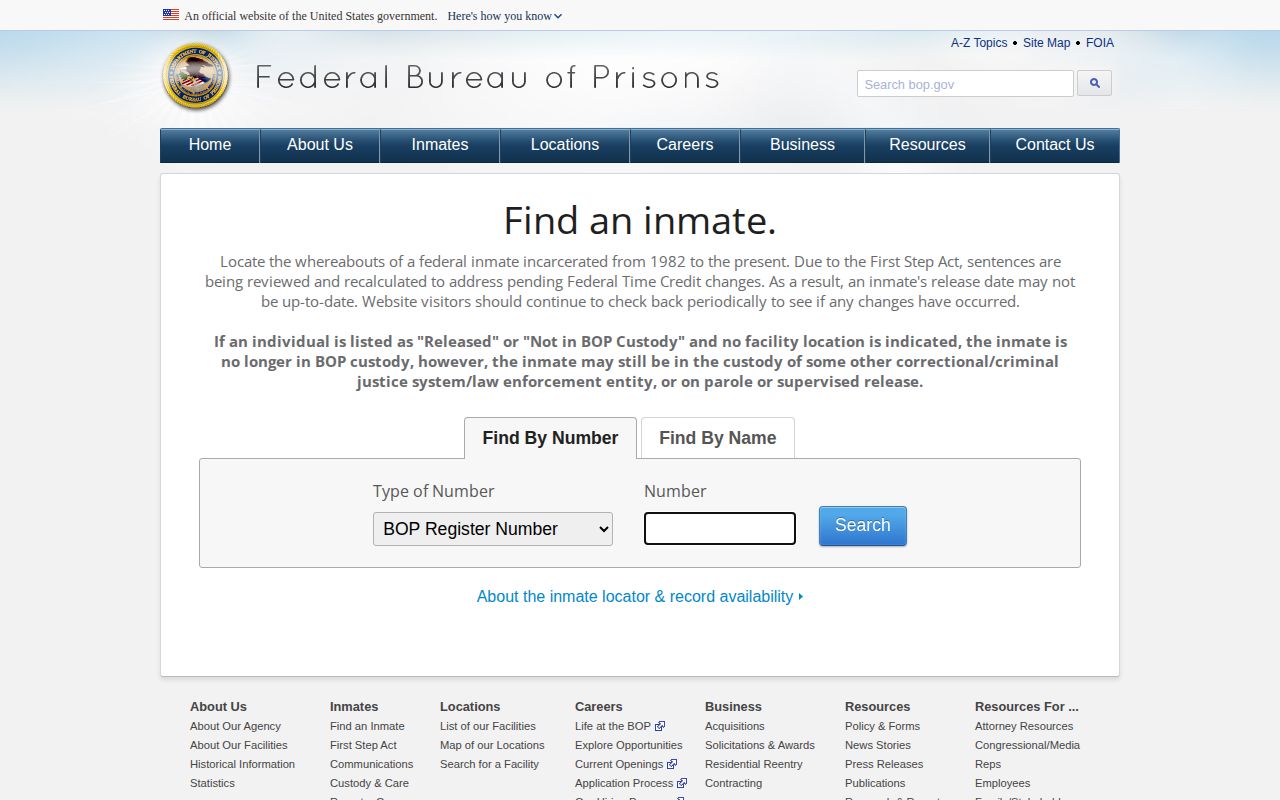
Federal custody is a different system again. The Federal Bureau of Prisons locator covers people in federal custody. It offers no routine public inmate-photo gallery. Immigration detention runs through ICE's Online Detainee Locator, which uses separate search keys and coverage. A blank result in one system says nothing about the others.
Check the event date, arrest agency, court, and custody status separately. People move between these systems. No single public screen records every step from arrest through final disposition.
Note: A release, transfer, court result, and expungement are different events. They should not be treated as the same status.
Massachusetts Record Archives
Keeping a record is not posting it online. The Massachusetts State Archives schedule fixes minimum retention periods for covered state record series. It spells out how files are preserved or destroyed. Municipal police records fall under a separate schedule with its own categories. Neither document sets a posting rule. An agency is not told to leave a booking log or photo on its website for any set time.
Start with the agency that made or held the record. Ask whether the file still sits in its current system. When a state record has moved on, the Massachusetts Archives can search its finding aids. Staff will say whether it is processed and open. Any request should name the institution, the person, the record type, and a date range. The archival route supplements rather than replaces a current police, sheriff, DOC, or court request.
Correctional schedules often keep booking and commitment records for decades. The exact span depends on the series and the person's release. No single statewide rule applies in Massachusetts. Nothing sets how long booking photos stay online. An old third-party page proves nothing. It cannot show what an official agency still holds today.
Note: Always check the current retention schedule before assuming an old record was destroyed or remains on hand.